Super Smash Bros Melee came out in 2001 for the GameCube , and it’s one of the videogames with the highest skill ceiling (and floor) that I know of, proof of that is that there are a lot of people still playing it professionally. I’m not good at all, SSB4 was the only one where I put in the hours, but I know enough to understand the complexity, and it’s extremely impressive. 1
Its difficulty can be divided in 2 levels. On a low level, the game runs at 60 fps and many techniques only have a 1-2 frame window to perform correctly (no input buffer!). Competitive Melee players average 6 actions per second, and have to master tech like Wavedashing, L-Canceling or Dash Dancing. Some of these techniques were not intended by the developers, which to me makes it even more interesting.
On a high level it’s more of a mindgame. Humans react in about 12 frames and many attacks are faster than that, so most of the time you are predicting your opponent, not reacting. Good players spend whole games conditioning the other one to expect something. I enjoy watching it much more than any other fighter as it does not rely as heavily on combos and is much more “free-form”.
I had seen some activity on twitter on recent advancements on AI bots taking on some top players, which seemed incredible to me, and decided to explore this during 1hack , an event where we get together for 24 hours to build whatever is on our mind, and ended up giving a short presentation at the end!
Started with a vague idea of having LLMs play the game directly. Some of the best ways of measuring the performance of latest models are based on having them play games that are out of the training distribution. Most game benchmarks are turn-based (chess, Pokémon, Slay the Spire … lots of these popping up lately). This did not work as expected but got me interested in the topic, my objective with this post is to write what I would have liked to have read when I started learning.
I think its an extremely exciting moment to get into this, with a lot of work to do and low-hanging fruit to get started!
Some history
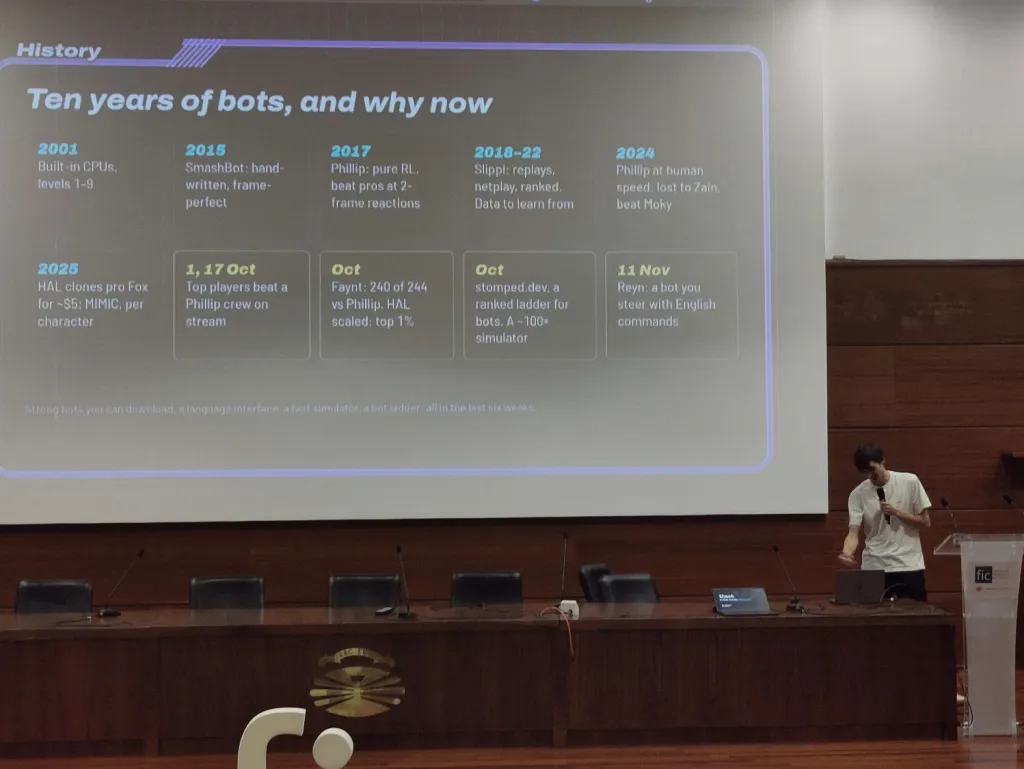
Melee itself was made in about 13 months (reaaally fast) and was the GameCube’s best selling game. The game shipped with built-in CPUs, levels 1-9. They are not great and any experienced player can beat them easily, mostly because they repeat moves and strategies constantly. It wasn’t until 2015, where Dan “altf4” Petro presented, SmashBot (great DEFCON talk!), a Fox bot that he wrote by hand using GOFAI. His main advantage was that it acted frame-perfect and with zero reaction time, but players quickly understood its tactics and exploited them until they were patched by hand. However, the heavy lifting of reverse engineering the game eventually became libmelee
 , which almost every bot since is built on.
The optimal melee game
A brief intermission to talk about a thought experiment Dan shares at the end of his talk: what would two perfect bots play against each other? I went deep into the rabbithole on this one.
Brute-forcing the deadlock3 min
Paraphrasing, his answer was:
Every projectile can be reflected within a two-frame window, so throwing them is pointless.
The fastest move in the game is Fox’s shine, which hits on its very first frame. So two perfect Foxes walk toward each other until they’re exactly in range and shine on the same frame. The shines cancel2, and from then on it’s a deadlock.
Best play for both is to jump and multishine, frame-perfectly, until the clock runs out. Then the game goes to Sudden Death, where bob-ombs fall from the sky, apparently at random.
But they aren’t random, melee RNG is predictable3. The real optimal strategy then is to steer the game so that when the deadlock ends eight minutes later, the generator is in a state that drops the bombs where your opponent has to choose between running into your shine or into a bomb.
Me being a fan of these kind of thought experiments, poked some holes at it, and since we now have the decompiled source code I ended up trying to brute force the answer. That turned into melee-brute, a fork I made of melee-sim-light that can explore the search space much faster than any traditional emulator. It’s honestly just a bunch of clever Fable tricks optimising for this use case but I think it can be pretty useful for other stuff!
The deadlock that Dan mentions does seem to be real, but not for that reason. Walking in and shining isn’t actually the best play. Since the attack only reaches about 10 units, any other attack like Fox’s jab, that hits from 21, can stop the aggressor on the way in.
I then thought that maybe some other character can hit Fox in a way he can’t react to (this is a perfect Fox, it’s as if he can read the game memory, so he sees every move on the frame it starts). So I tried every character’s moves against a Fox answering on the next frame, from a gap of 12 to 404 units and nothing got through. The defender is able to punish or block any of the approaches.
The shine, coming out on frame 1 while Fox is intangible, is the main blocker. It’s also the only move in the game that hits before any theoretical perfect opponent can react, so nobody can stand in that small circle around Fox. Falco has the same shine, but it reaches 8 instead of 10.
So we know the optimal game has to be a fox ditto, which kind of makes the whole experiment useless as whatever plan one Fox has, the other can play it mirrored, and neither Fox can be ahead from the start. 5 Either both can stand there safely forever (the original deadlock), or both are forced into guesses that, as far as I’ve tested, always balance out 50/50.
For example, one Fox attacks and walks in, stops at 13.2 distance units and flicks the stick away. Now blue has to pick between shining, stepping away or waiting, a rock-paper-scissors with no better or worse answer.
If the defender never wants to guess, he can step back, which will always be safe even if the attacker sees it coming. The attacker could try to keep walking in until there’s no stage left. Once both are in shine range it’s still a guessing game, but no longer an even one. Played 100 times, looking 8 frames ahead (about 16 million game states), the attacker lands the first hit or the defender slides off the stage ≈ 34 times, the defender lands it ≈ 8, and ≈ 58 times nobody is hit.
This squeeze would only work on a Fox who refuses to ever guess, and a perfect one doesn’t need to. In the middle of the stage the guess the attacker offers is worth the same to both, so he can just take it there instead of backing into a bad ledge.
As far as I can search, it is a stalemate. There still is a lot of ground to cover, my search only looks 8 frames ahead and on a limited pool of actions. More details on the experiments are on the Brute page . I might be missing something, so if you have any ideas please reach out to me!
Back to History
In 2017, Vlad Firoiu published Phillip, trained end to end with asynchronous RL. He trained a network per character and used a naive reward (KOs + Damage Dealt*weight) with actor-critic and self-play. It was able to beat some professional players, though mostly because it could react in about 2 frames where a human needs around 12. Still was quite exploitable, as some players found that simply crouching on the ledge would cause it to eventually suicide.
The same year, Sharma and Friedman trained a recurrent DQN that had to act with a 12-frame delay, closer to a human. Vlad’s own follow-up in 2018 (“At Human Speed”) did the same with Phillip: plain RL collapsed under the delay, and adding a learned model that predicts the game brought it back.
In the following years Slippi got popular, allowing for replay files, rollback netplay, a ranked ladder… Accumulating hundreds of thousands of recorded human games to learn from changed the recipe: copy humans first, then improve with RL. Project Nabla
 (Bryan Chen, 2022) was an early example: a small recurrent network cloned from about 100k tournament replays, then PPO, playing with 2 frames of delay.
None of these bots look at the screen. They read the game’s memory every frame (positions, speeds, animation and how far into it, damage) and answer with a whole controller state. DeepMind’s AlphaStar for StarCraft II followed the same recipe: real time, cloned from human replays, then self-play with a penalty for drifting away from human play.
The big one is Vlad’s second Phillip, slippi-ai: in the works since 2020 and playing top players in 2024, it copied humans from ranked and pro replays first, then improved by self-play, with a human-like reaction delay built in: it sees the game 18 to 24 frames late. It’s a recurrent network that picks the controller in two steps, one of 728 combinations of buttons, triggers and C-stick, then one of 85 main-stick positions.
Not too long after, in 2025, Eric Gu released HAL (Fox only): a 20M transformer cloned from pro Fox games for about $5 of compute, which beat the level 9 CPU 95% of the time. erickfm took the same recipe to MIMIC, one model of about 20M per character, with a dedicated button head so it can wavedash and a little RL on things like L-cancel rate. Then came a scaled-up HAL: 247M parameters with 256 frames of context, steered by asking for a level of play or a player’s style. It predicts 4 frames of inputs at a time to hide its compute time.
Now in late 2026, Frisson Labs released Faynt (paper), one 10M-parameter transformer that plays all 26 characters. It’s trained in three stages: behaviour cloning on about 840,000 ranked replays, a “winner curriculum” that ends on games won by Master-ranked players (distilled from a 75M sibling), then self-play RL in Fox mirrors with 96 emulators on one GPU. It plays with zero reaction delay and won 240 of 244 games against Phillip’s public releases. It was followed by Reyn, a bot you can steer with English commands, but with no LLM inside: Frisson labelled human replays with rule-based instructions (“this is a grab”), trained the policy to follow them, then froze it and trained small adapters with RL. A router maps whatever you type onto a fixed menu of about 100 commands, or rejects it. That detail matters later.
14 seconds of a bench game, redrawn from the replay file: Faynt (blue) takes a stock off Phillip (red), both playing Fox.
All this cool work is enabled by the community (like the recently opened stomped.dev, a ranked ladder for bots only with a nice discord community), that has built the open tooling over time that allows for this kind of experimentation, most recently leveraging AI to complete the decompilation of the full Melee code, that also gave us melee-sim-light, which runs the decompiled game without an emulator, about 100 times faster than headless Dolphin.
TAS
Next to the bots there’s also a scene of tool-assisted play (TAS), in which a sequence is built frame by frame in an emulator. It’s mostly used to show the limits of the game. I feel like my fork might be useful here, but never got into it so I’m not sure.
Started in 2005 with Action Replay videos made in the game’s hidden frame-by-frame debug mode. Around 2010 Dolphin got proper TAS tools (savestates, frame advance, input movies), and later Lua scripting on top, like PracticalTAS’s ssbm-lua-core. Some cool showpieces: combos that all end at exactly 69 hits, and Target Test for all 25 characters. Many findings end up flowing back to human play.
Benchmark
Using Slippi’s Dolphin emulator, Fox mirror on FD and Battlefield, I put every relevant bot that I could find and a couple of my experiments. Everything goes into one Elo fit with the level 9 CPU pinned at 1500. Then left it overnight playing thousands of games.
LLMs are a special case since they are too slow to press buttons every frame (16.7 ms) so each setup gives them a higher-level job and lets something faster handle the frames. They read about 500 tokens of game state with a rolling context window.
- Play, untimed: pick a move and the game pauses while they think. This measures how good their choices are.
- Play, live: same but no stops.
- Coach Reyn: Reyn plays every frame, and every 5 seconds the LLM coach uses text to condition its play style.
- Write a bot: a coding agent gets 30 minutes, a sandbox and a practice tool to write a Python bot that then plays like any other entrant.
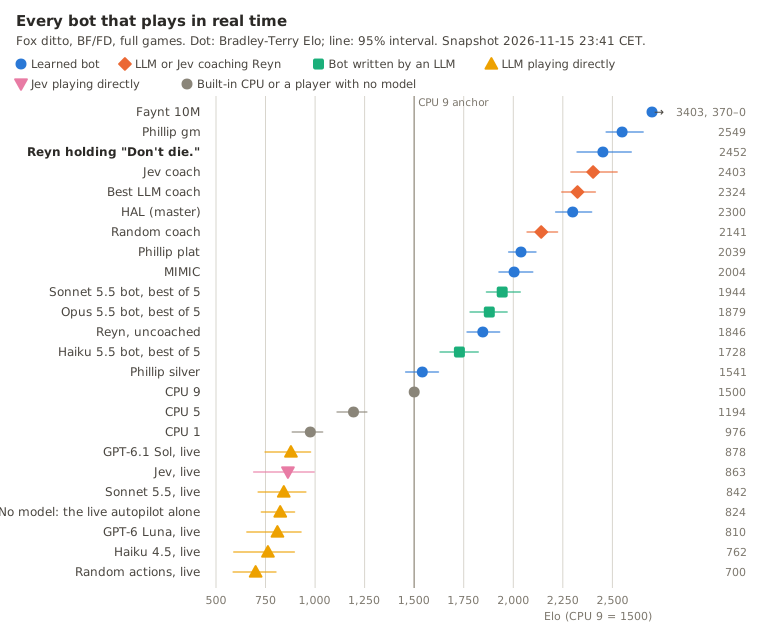
The learned bots are far ahead!
LLMs
Playing
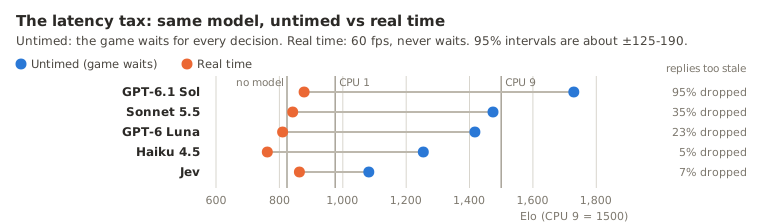
Given time to think, GPT-6.1 Sol beats the level 9 CPU (1729). Live, all of that disappears: every model drops 492 to 851 points, below the level 1 CPU (762 to 878).
Screenshots don’t help either: given an image instead of the text, models performed generally worse. LLM Colosseum had a similar finding in Street Fighter.
Coaching
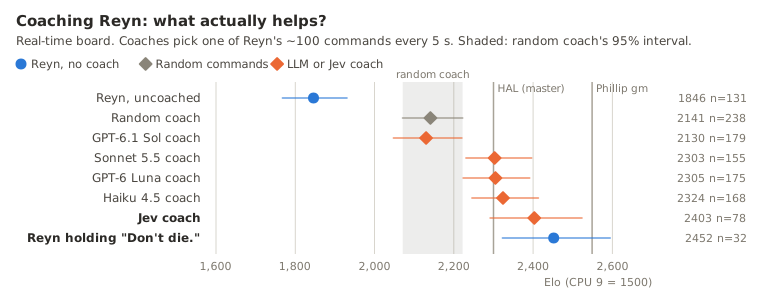
Reyn on its own rates 1846. With an LLM picking one of its ~100 commands every 5 seconds, it climbs to about 2300, HAL’s level. Surprisingly, Reyn holding “Don’t die.” all game, with no coach at all, gets to 2452, above every LLM.
Coding
I gave Claude Code 30 minutes, a sandbox and a practice tool to write a Python bot, starting from a 60-line bot that runs at the opponent and up-smashes. Turns out that starter is already above the level 9 CPU.
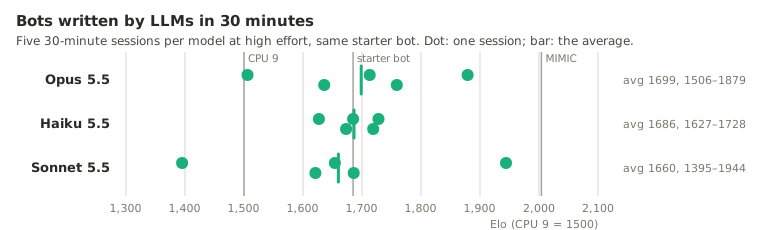
All three end up level with the starter: Opus 1699 on average, Haiku 1686, Sonnet 1660. Sessions of the same model differ by hundreds of points.
Training my own bot
After finding an intersection of my hobbies such as Melee and training neural networks, it’s only natural to train my own AI bots. These were my first steps, I’m just getting into the community and understanding the state of the art, so might make an update later!
My goal was to make the best Yoshi (my main) I could. Started by training my own small transformer on human Yoshi replays, the way HAL does. The best one beat the level 9 CPU, but lost every game to the serious bots, and self-play RL in the simulator made it worse in the real game. To check my pipeline I retrained HAL’s 20M Fox with it and found a bunch of bugs… Also tried making some primitives for specific Yoshi tech and labelling it in training data, but it didn’t seem to be useful.
Delay seems like one of the biggest problems to solve. On stomped.dev the bot sees the game 10 frames late if playing from my server6, which heavily affects its performance. It still double-jump cancels and L-cancels, but parries, which have to land in Yoshi’s 6-frame shield start-up, go from 0.17 a minute to almost none (0.02).
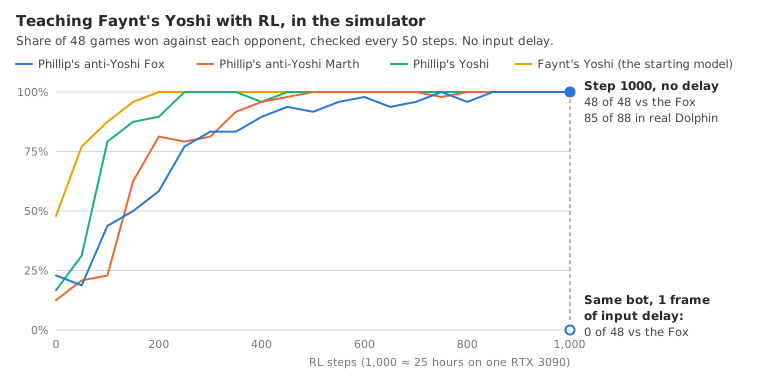
Finally I switched the base to Faynt’s 10M model, which plays Yoshi better than HAL out of the box, and ran RL against Phillip’s anti-Yoshi bots inside melee-sim-light (60x faster than Dolphin). After 1,000 steps (about a day on my 3090) it won 85 of 88 games in Dolphin, by far my best Yoshi, but only with no delay. I’m now training it further with the delay raised step by step up to 10 frames, we’ll see how that goes.
Other stuff
A website where I recorded my investigations and experiments, with every game being played live in 2D and my model training runs live, among other stuff.
An AI commentary booth with two casters. A fast LLM watches the game’s events and ElevenLabs voices them.
I’m also looking for interesting things to do with melee-brute. At its current speeds, it can only reach a conclusion under very restrictive situations, but for questions like “was there any possible way of surviving this specific edgeguard?” it can work.
Also thinking of enabling a way to play my bots live via netplay if there’s interest. Talk to me!
highly recommend AsumSaus
and PracticalTAS if interested in learning more! ↩︎If both do shine on the same frame on the ground, they don’t cancel into a multishine war, the hitboxes clank and both freeze for 4 frames. ↩︎
It would be practically impossible for the bot to control RNG, as the opponent’s moves also advance it. Also under tournament rules there is no Sudden Death: a timeout goes to whoever has less percent, and a tie on percent is replayed as a single stock game of 2 or 3 minutes, which would deadlock the same way. ↩︎
Since that’s how close any character can get to him under the best of circumstances. ↩︎
Kind of, Melee is a weird game, for example some exact ties are resolved in port order. Both attacking on the same frame does end even, though, and at shine range a grab loses to the shine, so this doesn’t break the deadlock afaik. ↩︎
Would only be 2 if I rented a box next to their server but I kinda want the challenge ↩︎