The objective of this post is to discuss some concepts related to the field of memetics. It was inspired by reading Antimemetics: Why Some Ideas Resist Spreading by Nadia Asparouhova.
Intro
Others and I share the impression that we are witnessing the emergence of a new field . While memetics were introduced by Richard Dawkins in 1976, and they were studied intensively during the 1990s and early 2000s, it died shortly after due to inability to agree on basic definitions and how to do empirical research. At this point in time, the context around the field has changed so much 1 that it feels like a whole new discipline (though there is still a lot to learn from back then).
Bringing the study of memetics more into the public is something I’m quite interested in, as I referenced in a previous post (On the growing importance of cogsec). As our societies progress, the flow of information and ideas will increase substantially, as well as the (economic) value associated with it. The incentives might not be in the correct places for private and public entities (they certainly are not right now) and this can lead to catastrophic consequences. Early exposure to the mechanisms of how ideas spread can help alleviate this.
The book, while short, succeeds in putting into print a lot of the principles of the contemporary study of memetics. It is part of the The Dark Forest Collective published pieces. They are a group of internet writers who focus on how people are moving away from public online spaces toward more private, safer, and context-rich one, denominated “dark forests ”, as a response to adversarial dynamics on the public web. I really appreciate their work, though sometimes you do realize that they are not really young and how that shapes their view. They try, but they don’t really “get it” the same way a digital native does, though I must admit lately I’m feeling a bit like that too
 .
History
Dual inheritance theory proposes to explain human behavior as the product of two evolutionary processes, genetic evolution and cultural evolution 2, that interact in a feedback loop.
Memetics is the study of how memes (units of cultural information like ideas or behaviors, anything that can be passed on via social learning) are transmitted, replicated, and evolve within a culture. It’s a lens for studying cultural evolution, putting emphasis on the ability (or inability) to capture attention. Human attention (not the other one) is a scarce resource, making the spread of memes limited and forcing them to adapt to changing environments to survive, setting the stage for a evolutionary process to happen.
Comparing cultural to biological evolution (memes to genes) is not a great research direction, as we’ll see later, but it can be useful in some contexts. Biology studies the patterns of matter that survive, whereas memetics studies patterns of behavior that survive. Memes generally work as symbionts with human hosts, and evolve ways of embedding in & transmitting between them. The coevolution of genes and memes also plays a crucial role, as they balance each other out in interesting ways.
Memetics has a complicated history, since it’s such an abstract topic, the terminology and writing is all over the place. Researching this felt quite similar to my dive into Cybernetics. Both emerged from interdisciplinary roots, struggled with ontological debates and fell from grace with the mainstream. Both focus on systems, feedback loops, and information (the spread f a meme is a classic positive feedback loop). You could frame memetics as a subfield of cybernetics. They are also common words in schizoposting .
In here I’ll focus on memetics as a science, though many philosophers have been talking about it for quite some time . This section is not exhaustive, I’ll mention some people and ideas that caught my attention, but for a more complete walkthrough check out this posts by Tim Tyler (until 2012), Agner Fog
 (until 1999) and Susan Blackmore
 . While many of their ideas seem obsolete as of current times, they remain very quite insightful.
Darwin seemed to show some understanding of cultural evolution in the context of language (The Origin of Species, 1859). Other early approaches include The Crowd: A Study of the Popular Mind (1896), but the field remained mostly underground until the publication of ‘The Selfish Gene’ (1976) by Richard Dawkins, that dedicated a chapter to this topic and coined the term meme.
The 80s and 90s started seeing some early developments in it’s theoretical foundation. It went through a bit of a golden age with the launch of the Journal of Memetics (1997–2005), that was home to much of the research in this period. Susan Blackmore’s The Meme Machine (1999) was one of the most influential writings, advancing on the ideas of Dawkins. During the 2000s there was a period of decline, as outlined by Bruce Edmonds in an essay where he explained the issues that led to the journal’s cessation: absence of consensus, over-reliance on biological metaphors, reductionism and lack of empirical research due to difficulty. A 2020 analysis comparing the rise and decline of memetics with the relative success of gene-culture coevolution theory blames the fixation on using discrete units of selection (that would allow it to be compared to the biological gene) and excessive emphasis on ontology over hypothesis testing.
This downward period coincided with the surge of memes in popular culture as the internet got introduced to the public. I believe that the most advance research in memetics is currently done by tech giants, political organizations and the military
 behind closed doors 3, as the The War for Attention
 rages on quietly. In The Case Against Marketing I showed how it’s nothing more than the art of hijacking attention, and how it has been the main source of cultural evolution for quite some time. Most social sciences also interacts with the field constantly, but it is rarely acknowledged. Limor Shifman’s book _Memes in Digital Culture
 _ (2013) redefined the term, departing significantly
 from Dawkins’ original by limiting it to only memes in the digital world. Since Shifman’s reformulated, academic research on memes resurged slightly, but with a much narrower scope. LLMs are starting to allow for much more in depth analysis of multimodal domains, most of it focused on hate speech, misinformation and crises.
Interestingly some academics try to distance themselves as much as possible from the term “memetics”. Researchers like Boyd and Richerson’s
 work in cultural evolution is quite successful, but they use terms like ‘cultural variant’ to avoid comparisons to biology and put much more emphasis on the gene-meme coevolution. In general they are a watered-down version of memetics with less emphasis on Darwinian theory and symbiosis. They seem to have gotten the empirical testing part right though.
In my opinion most of the interesting work is being done outside academic structures. Initiatives like the Open Research Institute are bringing research into the public, though they are still quite early. Their members have some of my favorite posts
 on the subject, that serve as a great introduction point. I will leave links to interesting people and content on the resources section at the end, but I want to highlight the open-memetics-institute
 and X community as some of the most vibrant places around.
Categories and Attributes
A useful way of understanding memetics is as a graph, where nodes are the entities that can receive memes and choose to transmit them, and the edges the connections between them. In here we can introduce concepts like degree (number of edges it has), immunity (nodes in a network that are resistant to infection), transmission rate (probability that an infected node will successfully spread an idea to its edges (connections) ), symptomatic period (how long an infected node actively “expresses” the idea); in the memes we have Fidelity (how accurately it reproduces), Fecundity (the speed and volume of its replication) and Longevity (how long it persists).
A node typically goes through 4 phases when getting infected, assimilation, retention, expression and transmission. At each of these stages there is some amount of selection going on, meaning that some memes will disappear from the node. Borrowing from epidemiology, the basic reproduction number is the expected number of cases directly generated by one case in a population where all individuals are susceptible to infection. There are some funny attempts at expressing all of this mathematically, comparing it to infectious diseases, but I don’t give much credence to them.
In Kevin Simler’s essay Going Critical there are a bunch of great interactive visualizers for the above. There he also present the following idea:
there’s a precise tipping point that separates subcritical networks (those fated for extinction) from supercritical networks (those that are capable of never-ending growth). This tipping point is called the critical threshold, and it’s a pretty general feature of diffusion processes on regular networks.
Memeplexes are group of memes that are typically present in the same node, like a particular aesthetic or ideology. It’s also useful to differentiate them based on the realm the exist. A memotype is the form of the meme in an individual’s mind, a mediotype is the physical medium or representation (text, image, etc.) and a sociotype is the distribution of a meme within groups or communities.
Nadia also proposes a way of categorizing memes according to their transmissibility and impact (derived from the previous attributes):

I had a notion of what an antimeme was from qntm’s There Is No Antimemetics Division , and turns out that it was a big inspiration for the book. In fact, I was already aware of most the people and ideas discussed in the book (including qntm’s work) as the author seems to frequent a quite similar internet to me. The citations pages at the end felt eerily alike my bookmarks
 .
Antimemes involve ideas that resist being remembered, comprehended, or engaged with, despite their significance. When a person encounters an antimemetic idea, there’s a conscious or unconscious desire to suppress it. Some examples include Daylight Saving Time (that despite widespread dislike and evidence of negative impacts, the practice persists), Taboos (global poverty is a truth that is too heavy for our minds to constantly hold)… I won’t get too deep into this particular concept, you should read the book if you are interested.
One of the big differences on biological evolution to cultural is on how the transmission happens. Vertical transmission occurs when information (values, DNA…) is passed from parents to their children. Horizontal transmission happens among members of the same generation that are not direct family, and is much faster and flexible. Both kinds of evolution exhibit both kinds of transmission, but culture relies much more on horizontal and vice versa for bio.
Another good way of categorizing memetic information is by how the value it provides to humans change when it spreads . Memetic-invariant information remains constant in value if more people learn it (the sky is blue), memetic-cooperative information becomes more valuable if more people learn it (centralized fiat) and memetic-competitive information becomes less valuable if more people learn it (an undervalued asset). Most social media (and the broader information economy) exists to propagate memetic information. As memetic-competitive information is anti-memetic (no one wants to spread it, lest it loses value), it makes sense why it’s mostly filled with cooperative memes.
While memes might have certain amount of agency, it would be problematic to attribute moral value to them. We can however differentiate between Symbionts (memes that benefit their hosts, making them more likely to survive e.g. washing your hands) and Parasites (memes that harm their host but are effective at replicating).Parasitic memes are of particular interest, as being able to recognize them will help us to avoid them better. One of the keys lies in that they must endure the selection process while damaging their own hosts at the same time, which forces them to be really effective at replicating. This can apply both to a individual node and to the network, though those that are beneficial to the individual will be easier to spread.
This study traces the origin and development of the “Witch Hunt” meme during european prosecutions to answer the question: why did they persist and disseminate, despite the fact that no one appears to have substantially benefited from them? What they found was that the meme went through a Darwinian process, in which cultural variants of witchcraft beliefs accidentally triggered larger, more sensational, and more widespread persecutions, that were consequently better at spreading and replicating themselves.
The book heavily references The Elephant in the Brain and essays from both authors, Kevin Simler and Robin Hanson, both mentioned previously. The main idea of the book that humans often act with hidden motives, even from themselves, and that these motives are often related to self-interest, social status and signaling. This fits really nice with the concept of antimeme presented in the book, and helps explain how they emerged.
Our brains gently steer us toward narratives that makes us feel good, and away from those that don’t. When someone donates money to a charity, they tend to frame it as selfless altruism, rather than acknowledging motives like gaining power or assuaging guilt. These hidden, selfish motives are antimemetic: they remain invisible to the perceiver, because noticing them would present a challenge on how they see themselves. (page 75)
The Elephant in the brain is about one type of antimeme: selfish motives that threaten our self-image and social standing. But this same energy-preserving mechanism filters out any antimemetic idea that demands significant mental effort to process. (page 76)
While I enjoy both authors of The Elephant in the Brain, I find it that it relies a bit too much on anecdotal evidence scrambled together from all fields, which in turn does make it a good science communication book. The core idea has been discussed in much more detail in rationalist forums like LessWrong. The hostile telepaths problem presents a situation in which you’re dealing with a being (a) who can kind of read your internal experiences and (b) whom you don’t trust won’t make your situation worse due to what they find in you. This kind of situation easily explain the emergence of behaviors to deal with them. Even the controversial Ziz has some thoughts on the matter .
But antimemes can contain important information, so there is an interesting challenge in discerning the valuable ones and bringing them to the public eye. Here the author introduces the concepts of truth tellers and champions.
Truth-teller’s job is to air out our shared fears, doubts, and taboos to light. It has to know when an antimeme is ready for public consumption and how to present it in order to succeed. There have been people with this position since social learning emerged. Buffoons, oracles, shamans, tricksters, christian confession… all of these fulfill this role one way or another, and have proved vital to a proper cultural evolution. Even the occult and esoteric tradition, like Chaos magic, has it’s own word for memes, egregore 2.
Being shameless is not the same as truth-telling. The former is an act of self-interest for personal gain, while the latter is valued for it’s contribution to the collective interest. (page 96)
While the truth-teller surfaces antimemes into our collective consciousness, champions make sure that we keep paying attention to them, ensuring that these ideas are preserved and embedded into our institutions.
In a highly scaled and distributed marketplace of ideas, which issues we make progress on – the historic moments that come to define our story as a civilization – depends almost entirely on the quality of our champions.
Leslie A. White is an example of the truth-teller role (he described himself as the child pointing out the emperor is naked in the field of anthropology), with the publication ‘The Science of Culture: A Study of Man and Civilization’ (1949), where he introduced the term “culturology”. This was before the publications of The Selfish Gene, which would make Dawkins the undisputed champion is Dawkins of this example.
The book added more details and examples around these ideas, sometimes to their detriment, but I enjoyed them since most of them related to memes I have already been infected by. For example, it traces the surge of interest around a very specific type of meditation, called jhanas, and nails the chain of people that made this possible in my case (Qualia Research Institute -> Nick Cammarata -> Scott Alexander).
Attention is a precious, limited resource. We can’t expect to fully engage with every idea that enters our headspace. Yet at the same time, it’s clear that relying on unconscious filters can leave us blinded to opportunities that would otherwise be useful to see. (page 78)
Instead of trying to engineer a perfect hierarchy of attention, we should aim to cultivate a “biodiverse” information ecosystem (…) In biology, ecosystems with greater biodiversity are more resilient to shocks and better equipped to adapt to changing conditions (page 82)
As I briefly discussed in [consciousness is hard] the attention mechanism has a intricated relationship to consciousness. Our brain ingests enormous amounts of information every instant, but we are only conscious of a really small part, defining how we perceive the world. It is the bottleneck of the human brain, rather than computational power. The book discussed techniques like protocols and mnemonics as ways of optimizing our attention.
Risks
we are now living in what might be termed “late-stage memetic society” but “early-stage antimemetic society”: a patchwork of settlements that has opened it’s borders to refugees fleeing memetic contagion. (page 39)
This is one of the points where I disagree the most with the Nadia. We are not in late-stage memetic at all! There is a lot more to come!! AI will be extremely good at memetics (it already is), we are just starting to see internet capital markets being created, that allow for a much more close and immediate relationship from memetics to money, and the flow of information can still increase greatly before we get completely overwhelmed. In this section I will explore some of the dangers that I consider the most relevant for our future.
Memetic downside risks (MDRs) are defined as unintended negative effects that arise from how ideas evolve over time. They don’t necessarily need to be net negative, but its worth paying attention to them and mitigating if possible. Information hazards are risks that arise from the dissemination of true information that may enable some agent to cause harm (a subset of MDRs since those can be false as well). They come in many forms: data hazard, that contains specific content (eg. the blueprint to a nuclear bomb); attention hazard, where drawing of attention increases risk, even if the idea is already known); Neuropsychological hazards, where negative effects emerge from the particular ways in which our brains are structured; signaling hazard, template hazard… there are many others, that mostly rely on our biases and ignorance.
Information hazards are true by definition, but MDRs don’t have to be. For instance, compared to the claims of mainstream medicine, alternative medicine may seem simpler and more impressive. This might favor the selection pressure they experience and enable their short (relative) term spread.
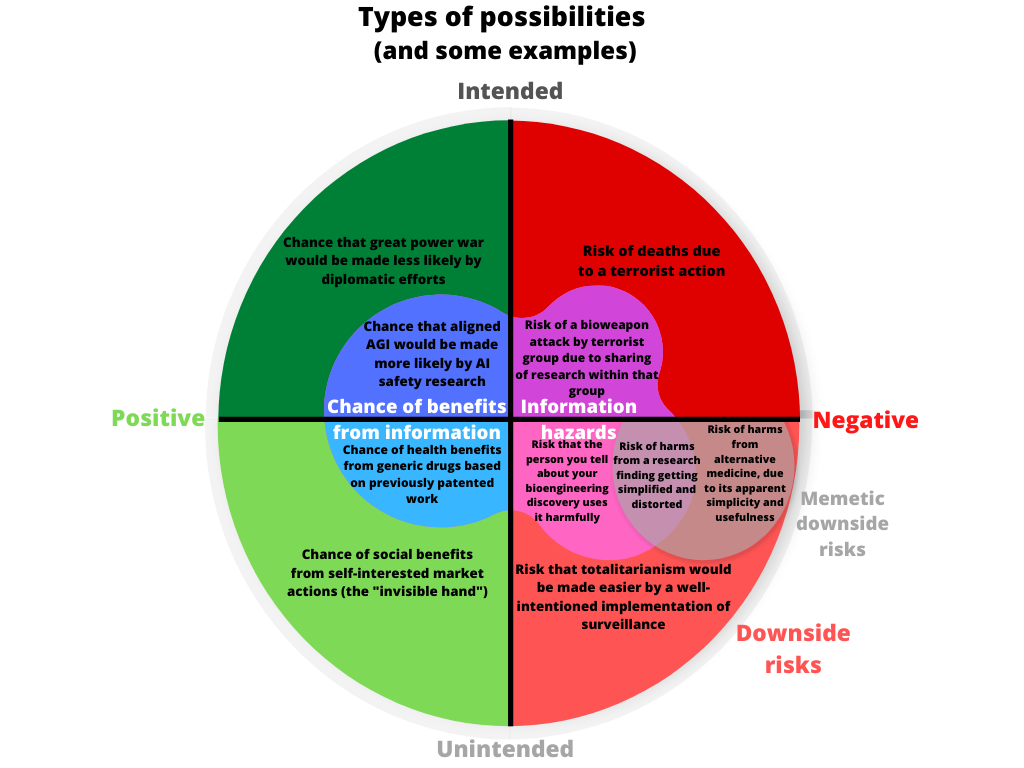
Ideas will often evolve towards simplicity, salience, usefulness, and perceived usefulness, each a different selection pressure. This does not necessarily mean that they are turning worse, in fact most ideas have improved over time following this template. Simpler ideas will require less attention and are much easier to spread. Ideas that are more salient cause stronger emotions, thus making them easier to remember and share.
Usefulness is a bit more complicated since it depends on the node’s perspective. Adaptation in this direction can be expected to be beneficial in most cases, but not always. For example, selection pressures over social signalling might help explain the increase on political polarization. Perceived usefulness happens when an idea isn’t actually better than others, but it appears as such. The easier it is to assess the true usefulness of an idea, the less this will apply. Ideas that rely too much on this tend to deteriorate the network.
There also exists a tendency for ideas to become noisier over time, in which random mutations are constantly modifying it, usually correlated to the amount of nodes it’s spread over. This already happens in genes, where genetic drift is the process by which random change influences the frequency of gene variants in a population (mutation without selection). It’s particularly relevant on small populations and can lead to loss of genetic diversity.
The phenomenon of “memetic drift4” seems to be one of Robin Hanson’s latest interests , as he worries that these small, cumulative changes can, over time, erode important cultural values and traditions with consequences for social stability. In the past, when cultures were under strong selection pressures, maladaptive changes were usually weeded out. In the modern era, cultural change is much faster and there is less diversity, which propitiates dysfunctions.
Fertility is possibly the clearest example , where he argues that recent decreases are a result of memes that encourage people to focus on meme propagation (social influence, status…) rather than genetic reproduction, which in turn could lead to our extinction. The other big risk he identifies is the loss of diversity and surge of a global “monoculture”, that would make societies more fragile and susceptible to large-scale negative shifts in values and behavior. Corporate and romantic cultures seem to suffer from the same problem, where the lack of error-correction mechanisms makes them degrade over time.
Proposed fixes include a conservative return, in which we adopt values proved by time; totalitarian cultural control or deep multiculturalism. The reason why diversity could solve this is that evolution between species is more important (more adaptive) than evolution within species, both in cultural and bio evolution. A problem with Hanson’s argument is that it relies on your perspective on current culture, while if it’s the true that it has maladapted, it makes sense for it to disappear. Surprisingly this does not happen as much on memes related to science, math or technology, presumably because interests of memes and genes are aligned in these fields, whereas in values they can be opposed.
Clown attacks are a tactic based on the fact that perception of social status affects what thoughts the human brain is and isn’t willing to think. State agencies are the ones that take the most advantage of this. By exploiting the human tendency to associate specific ideas with low social status, it will inhibit the human brain from pursuing that targeted line of thought. Examples include conspiracy theories being the main people who are seen talking about the Snowden revelation or right-wing clowns defending nuclear energy. They are difficult to handle because you’ll worry that, by entertaining that line of thought, you will lose status in the eyes of other people.
That is one particular kind of attack, but we know that the human brain is a amalgamation of spaghetti code and that it has exploits. The things is, you don’t really need to understand the whole system in order to make use of them. If we think of social media as a controlled environment for automated experimentation, with a extremely low cost to collect massive amounts of human behavior data, finding complex social engineering techniques is the kind of task where machine learning excels at. These vulnerabilities are not particularly well-hidden.
Supermemes, as defined by memes that contain high impact information with high transmissibility are also risky, mainly because of their scale. Early forms of religions like Judaism and Islam were “highly virulent" and infected big swaths of population, probably because it was a beneficial adaptation at the time. But,
when supermemes lack clear focus on specific outcomes, they can trap people in a state of perma-crisis that never fully escalates or resolves. (page 69)
Got people close to me that live like this, particularly worrying about immigration and demographics, and while those are perfectly valid problems, the amount of attention that it takes out of their daily lives makes this comparable to living with some illness like long-covid.
Propaganda is basically a memetic hazard on a national scale, and cognitive warfare / hybrid warfare has been a field in geopolitics for quite some time now.
Memetics have an interesting relationship to LLMs, since one of language’s main roles is the transmission of meme. The recent phenomenon of LLM induce psychosis seems quite relevant, as it points to the extreme competence that these AIs have in the manipulation and transmission of memes. AI alignment research would probably benefit from more attention to this lens.
As I argued in Mental illnesses and the Looping Effect, our psychology is increasingly being affected by what, in essence, are memetic attacks that evolution has adapted us to respond a certain way. Major traumatic events like genocides result in memes that carry the wounds and the coping strategies of whole communities. Some addictions are really strong memes that refuse to leave the host.
Prevention
One obvious idea is just to use your reason to differentiate between the good and bad memes an ignore the bad ones. For one, you can’t just ignore a meme, and rationality can sometimes serve as a “memetic immune disorder”, meaning that over-rationality can remove cultural antibodies, evolved against certain memes that might seem illogical. Listening to your emotional responses can help against this, we have a memetic immune system developed as the product of meme-gene coevolution that is actually quite good.
Some things you can do is start considering that some information environments might be adversarial (like hyper optimized impression hacking environments), minimize exposure to sensors (open webcams, avoid sleeping in the same room as a smart device…) end being more cautious about “low-fidelity” methods of spreading ideas (mass media, X…). Take into account that some downside risk might take more effort to prevent than the damage they do
Cognitive Behavioral Therapy can be thought of as a form of applied antimemetics. A person’s cognitive distortions (“I am worthless,” “Everyone is against me”) are antimemetic since they are painful to confront. A therapist acts as a private “truth-teller” in this context.
Future Directions
I think AI might bring a bit of a revival to memetics. It allows for quantitative analysis of all kind of data that was completely inaccessible before. There are many technologies that become available after this. Computer modeling of memetics was a dead end for many years, but the availability of embeddings and multimodal changes this.
By studying previous memes with new tools, we can use to test against our predictions. Meme extinction events are interesting as well, and meme paleontology sounds like a real job to me in a couple years. Some people are already working on this .
Crypto is maybe the industry that has the deepest understanding of memes, at least in their particular context. Meme tokens are literally financialized memetics, with people betting money on the memetic value of a particular image and letter combination . Funnily enough, research
 point to a "strong positive association between meme activities and negative earnings " in traditional stocks. I expect this to reverse as internet capital markets become more accessible.
This is about it for now, I wrote this in 4 frantic days while in vacation at Barcelona. As it keeps happenning, at about 75% of completeness of a project I loose interest, making my texts unstructured and and unpleasant to follow. My other big problem is that I tend to compress information too much in text, making important ideas difficult to differentiate from the rest. Anyway, thanks to pedro and niko for feeding me, giving me a place to stay and generally taking care of me during the this time.
More Resources
I encourage the reader to follow the link in the post, as the value of my content is more of curation rather than writing. In fact few ideas in here are really mine, but I enyojed exploring them.
-
nosilverv
is going to publish a book related to memetics soon. -
Can you eliminate memetic scarcity, instead of fighting? — LessWrong
-
Tim Tyler - Memetics: Memes and the Science of Cultural Evolution
-
wearehostsformemes/meta-meme.txt at master · lupuleasa-core/wearehostsformemes · GitHub
-
Why Care About Meme Hazards and Thoughts on How to Handle Them | Qualia Computing


Todo maybe
connect with free energy principle in the brain ??
memetic entropy as they evolve over time ?
Regarding the Pain of Others by Susan Sontag | Goodreads tried to memetic photography war and failed
In particular, the enormous increase of the free flow of information (and thus memes) permitted by the internet and globalization. ↩︎
I intended on writing a post on chaos magick and failed miserably. I took it as seriously as I could but I’m already quite bad at interpreting symbols in my daily life, so it was really difficult for me to find footing. Hopefully I’ll pick it back up at some point as it is a surprisingly deep field. ↩︎ ↩︎
Without getting too deep into this, quoting this LessWrong post
:
↩︎We’re already in the timeline where the research and manipulation of the human thought process is widespread; SOTA psychological research systems require massive amounts of human behavior data, which in turn requires massive numbers of unsuspecting test subjects (users) in order to automate the process of analyzing and exploiting human targets. This therefore must happen covertly, and both the US and China have a strong track record of doing things like this. This outcome is a strong attractor state since anyone with enough data can do it, and it naturally follows that powerful organizations would deny others access e.g. via data poisoning.
“Cultural drift” is kind of a synonym, referring more to memetic drift in population. ↩︎
Traducido con un LLM del original en inglés.
El objetivo de este post es comentar algunos conceptos relacionados con el campo de la memética. Surgió a raíz de leer Antimemetics: Why Some Ideas Resist Spreading de Nadia Asparouhova.
Intro
No soy el único que tiene la impresión de que estamos presenciando el nacimiento de un nuevo campo. Aunque Richard Dawkins introdujo la memética en 1976, y se estudió intensamente durante los 90 y principios de los 2000, murió poco después por la incapacidad de ponerse de acuerdo en las definiciones básicas y en cómo hacer investigación empírica. A estas alturas, el contexto alrededor del campo ha cambiado tanto 1 que parece una disciplina totalmente nueva (aunque todavía hay mucho que aprender de aquella época).
Acercar el estudio de la memética al público es algo que me interesa bastante, como ya mencioné en un post anterior (On the growing importance of cogsec). A medida que nuestras sociedades avanzan, el flujo de información e ideas va a aumentar sustancialmente, igual que el valor (económico) asociado a él. Puede que los incentivos no estén donde deberían para las entidades privadas y públicas (desde luego ahora mismo no lo están) y esto puede tener consecuencias catastróficas. Exponerse pronto a los mecanismos de cómo se propagan las ideas puede ayudar a mitigarlo.
El libro, aunque corto, consigue plasmar por escrito muchos de los principios del estudio contemporáneo de la memética. Forma parte de las piezas publicadas por The Dark Forest Collective. Son un grupo de escritores de internet que se centran en cómo la gente se está alejando de los espacios públicos online hacia otros más privados, seguros y ricos en contexto, denominados “dark forests”, como respuesta a las dinámicas adversariales de la web pública. Aprecio mucho su trabajo, aunque a veces te das cuenta de que no son precisamente jóvenes y de cómo eso condiciona su visión. Lo intentan, pero no lo “pillan” del todo igual que un nativo digital, aunque tengo que admitir que últimamente yo también me siento un poco así.
Historia
La teoría de la herencia dual propone explicar el comportamiento humano como el producto de dos procesos evolutivos, la evolución genética y la evolución cultural 2, que interactúan en un bucle de retroalimentación.
La memética es el estudio de cómo los memes (unidades de información cultural como ideas o comportamientos, cualquier cosa que se pueda transmitir mediante aprendizaje social) se transmiten, se replican y evolucionan dentro de una cultura. Es una lente para estudiar la evolución cultural, que pone el énfasis en la capacidad (o incapacidad) de captar la atención. La atención humana (no la otra) es un recurso escaso, lo que limita la propagación de los memes y los obliga a adaptarse a entornos cambiantes para sobrevivir, preparando el terreno para que se dé un proceso evolutivo.
Comparar la evolución cultural con la biológica (memes con genes) no es una gran línea de investigación, como veremos más adelante, pero puede ser útil en algunos contextos. La biología estudia los patrones de materia que sobreviven, mientras que la memética estudia los patrones de comportamiento que sobreviven. Los memes suelen funcionar como simbiontes con huéspedes humanos, y desarrollan formas de incrustarse en ellos y transmitirse entre ellos. La coevolución de genes y memes también juega un papel crucial, ya que se equilibran mutuamente de formas interesantes.
La memética tiene una historia complicada; al ser un tema tan abstracto, la terminología y lo que se ha escrito están por todas partes. Investigar esto me recordó bastante a cuando me metí de lleno en la Cybernetics. Ambas surgieron de raíces interdisciplinares, se atascaron en debates ontológicos y cayeron en desgracia para el mainstream. Ambas se centran en sistemas, bucles de retroalimentación e información (la propagación de un meme es un bucle de retroalimentación positiva de manual). Se podría plantear la memética como un subcampo de la cibernética. También son palabras habituales en el schizoposting.
Aquí me voy a centrar en la memética como ciencia, aunque muchos filósofos llevan bastante tiempo hablando de ella. Esta sección no es exhaustiva, mencionaré algunas personas e ideas que me llamaron la atención, pero para un repaso más completo echad un ojo a estos posts de Tim Tyler (hasta 2012), Agner Fog (hasta 1999) y Susan Blackmore. Aunque muchas de sus ideas parecen obsoletas a día de hoy, siguen siendo muy reveladoras.
Darwin parecía mostrar cierta comprensión de la evolución cultural en el contexto del lenguaje (The Origin of Species, 1859). Otros enfoques tempranos incluyen The Crowd: A Study of the Popular Mind (1896), pero el campo se mantuvo mayormente underground hasta la publicación de ‘The Selfish Gene’ (1976) de Richard Dawkins, que dedicó un capítulo a este tema y acuñó el término meme.
En los 80 y los 90 empezaron a verse los primeros avances en su base teórica. Vivió una especie de edad de oro con el lanzamiento del Journal of Memetics (1997–2005), donde se publicó gran parte de la investigación de ese periodo. The Meme Machine (1999) de Susan Blackmore fue uno de los escritos más influyentes, y avanzaba sobre las ideas de Dawkins. Durante los 2000 hubo un periodo de declive, como describe Bruce Edmonds en un ensayo donde explicaba los problemas que llevaron al cierre de la revista: falta de consenso, dependencia excesiva de las metáforas biológicas, reduccionismo y ausencia de investigación empírica por su dificultad. Un análisis de 2020 que compara el auge y la caída de la memética con el éxito relativo de la teoría de la coevolución gen-cultura culpa a la obsesión por usar unidades discretas de selección (que permitieran compararla con el gen biológico) y al énfasis excesivo en la ontología por encima de la comprobación de hipótesis.
Este periodo de bajón coincidió con la explosión de los memes en la cultura popular a medida que internet llegaba al público. Creo que la investigación más avanzada en memética la hacen actualmente los gigantes tecnológicos, las organizaciones políticas y el ejércitoa puerta cerrada 3, mientras The War for Attention sigue en silencio. En The Case Against Marketing mostré que el marketing no es más que el arte de secuestrar la atención, y que lleva bastante tiempo siendo la principal fuente de evolución cultural. La mayoría de las ciencias sociales también interactúan con el campo constantemente, pero rara vez se reconoce. El libro de Limor Shifman _Memes in Digital Culture_ (2013) redefinió el término, alejándose significativamente del original de Dawkins al limitarlo solo a los memes del mundo digital. Desde la reformulación de Shifman, la investigación académica sobre memes resurgió ligeramente, pero con un alcance mucho más estrecho. Los LLMs están empezando a permitir análisis mucho más profundos de dominios multimodales, la mayoría centrados en discurso de odio, desinformación y crisis.
Curiosamente, algunos académicos intentan distanciarse todo lo posible del término “memética”. El trabajo de investigadores como Boyd y Richerson en evolución cultural tiene bastante éxito, pero usan términos como ‘variante cultural’ para evitar comparaciones con la biología y ponen mucho más énfasis en la coevolución gen-meme. En general son una versión descafeinada de la memética, con menos énfasis en la teoría darwiniana y la simbiosis. Eso sí, parece que la parte de la comprobación empírica la han hecho bien.
En mi opinión, la mayor parte del trabajo interesante se está haciendo fuera de las estructuras académicas. Iniciativas como el Open Research Institute están acercando la investigación al público, aunque todavía están bastante verdes. Sus miembros tienen algunos de mis posts favoritos sobre el tema, que sirven como un gran punto de entrada. Dejaré enlaces a gente y contenido interesante en la sección de recursos del final, pero quiero destacar el open-memetics-institute y la comunidad de X como algunos de los sitios con más vida.
Categorías y atributos
Una forma útil de entender la memética es como un grafo, donde los nodos son las entidades que pueden recibir memes y elegir transmitirlos, y las aristas las conexiones entre ellos. Aquí podemos introducir conceptos como el grado (número de aristas que tiene), la inmunidad (nodos de una red que son resistentes a la infección), la tasa de transmisión (probabilidad de que un nodo infectado consiga propagar una idea a sus aristas (conexiones) ), el periodo sintomático (cuánto tiempo un nodo infectado “expresa” activamente la idea); en los memes tenemos la Fidelidad (con qué precisión se reproduce), la Fecundidad (la velocidad y el volumen de su replicación) y la Longevidad (cuánto tiempo persiste).
Un nodo suele pasar por 4 fases al infectarse: asimilación, retención, expresión y transmisión. En cada una de estas fases hay cierta selección, lo que significa que algunos memes desaparecerán del nodo. Tomando prestado de la epidemiología, el número básico de reproducción es el número esperado de casos generados directamente por un caso en una población donde todos los individuos son susceptibles a la infección. Hay algunos intentos graciosos de expresar todo esto matemáticamente, comparándolo con enfermedades infecciosas, pero no les doy mucho crédito.
En el ensayo de Kevin Simler Going Critical hay un montón de visualizadores interactivos geniales de lo anterior. Ahí también presenta la siguiente idea:
there’s a precise tipping point that separates subcritical networks (those fated for extinction) from supercritical networks (those that are capable of never-ending growth). This tipping point is called the critical threshold, and it’s a pretty general feature of diffusion processes on regular networks.
Los memeplexes son grupos de memes que suelen estar presentes en el mismo nodo, como una estética o una ideología concreta. También es útil diferenciarlos según el ámbito en el que existen. Un memotipo es la forma del meme en la mente de un individuo, un mediotipo es el medio físico o la representación (texto, imagen, etc.) y un sociotipo es la distribución de un meme dentro de grupos o comunidades.
Nadia también propone una forma de categorizar los memes según su transmisibilidad y su impacto (derivados de los atributos anteriores):
Tenía una noción de lo que era un antimeme por There Is No Antimemetics Division de qntm, y resulta que fue una gran inspiración para el libro. De hecho, ya conocía a la mayoría de la gente y de las ideas que aparecen en el libro (incluido el trabajo de qntm), porque la autora parece frecuentar un internet bastante parecido al mío. Las páginas de citas del final se parecían inquietantemente a mis bookmarks.
Los antimemes son ideas que se resisten a ser recordadas, comprendidas o tenidas en cuenta, a pesar de su importancia. Cuando alguien se encuentra con una idea antimemética, hay un deseo consciente o inconsciente de suprimirla. Algunos ejemplos son el horario de verano (que a pesar de que no le gusta a casi nadie y de las pruebas de sus efectos negativos, se mantiene), los tabúes (la pobreza global es una verdad demasiado pesada para que nuestra mente la sostenga constantemente)… No voy a profundizar mucho en este concepto en concreto, deberías leer el libro si te interesa.
Una de las grandes diferencias entre la evolución biológica y la cultural está en cómo se produce la transmisión. La transmisión vertical ocurre cuando la información (valores, ADN…) pasa de padres a hijos. La transmisión horizontal se da entre miembros de la misma generación que no son familia directa, y es mucho más rápida y flexible. Los dos tipos de evolución presentan los dos tipos de transmisión, pero la cultura depende mucho más de la horizontal, y al revés en el caso de la biológica.
Otra buena forma de categorizar la información memética es según cómo cambia el valor que aporta a los humanos cuando se propaga. La información memético-invariante mantiene constante su valor si más gente la aprende (el cielo es azul), la información memético-cooperativa se vuelve más valiosa si más gente la aprende (el dinero fiat centralizado) y la información memético-competitiva se vuelve menos valiosa si más gente la aprende (un activo infravalorado). La mayoría de las redes sociales (y la economía de la información en general) existen para propagar información memética. Como la información memético-competitiva es antimemética (nadie quiere difundirla, no vaya a perder valor), tiene sentido que estén llenas sobre todo de memes cooperativos.
Aunque los memes puedan tener cierto grado de agencia, sería problemático atribuirles valor moral. Lo que sí podemos es diferenciar entre Simbiontes (memes que benefician a sus huéspedes y hacen que tengan más probabilidades de sobrevivir, p. ej. lavarse las manos) y Parásitos (memes que perjudican a su huésped pero son eficaces replicándose).Los memes parásitos son especialmente interesantes, porque saber reconocerlos nos ayudará a evitarlos mejor. Una de las claves está en que tienen que aguantar el proceso de selección mientras dañan a sus propios huéspedes al mismo tiempo, lo que les obliga a ser realmente eficaces replicándose. Esto puede aplicarse tanto a un nodo individual como a la red, aunque los que son beneficiosos para el individuo serán más fáciles de propagar.
Este estudio rastrea el origen y el desarrollo del meme de la “caza de brujas” durante las persecuciones europeas para responder a la pregunta: ¿por qué persistieron y se difundieron, a pesar de que nadie parece haberse beneficiado sustancialmente de ellas? Lo que encontraron fue que el meme pasó por un proceso darwiniano, en el que variantes culturales de las creencias sobre la brujería desencadenaron accidentalmente persecuciones más grandes, más sensacionalistas y más extendidas, que en consecuencia eran mejores propagándose y replicándose.
El libro hace muchas referencias a The Elephant in the Brain y a ensayos de sus dos autores, Kevin Simler y Robin Hanson, ambos mencionados antes. La idea principal del libro es que los humanos a menudo actuamos con motivos ocultos, incluso para nosotros mismos, y que estos motivos suelen estar relacionados con el interés propio, el estatus social y el signaling. Esto encaja muy bien con el concepto de antimeme que presenta el libro, y ayuda a explicar cómo surgieron.
Our brains gently steer us toward narratives that makes us feel good, and away from those that don’t. When someone donates money to a charity, they tend to frame it as selfless altruism, rather than acknowledging motives like gaining power or assuaging guilt. These hidden, selfish motives are antimemetic: they remain invisible to the perceiver, because noticing them would present a challenge on how they see themselves. (page 75)
The Elephant in the brain is about one type of antimeme: selfish motives that threaten our self-image and social standing. But this same energy-preserving mechanism filters out any antimemetic idea that demands significant mental effort to process. (page 76)
Aunque disfruto de los dos autores de The Elephant in the Brain, me parece que se apoya demasiado en evidencia anecdótica rejuntada de todos los campos, lo que, por otro lado, lo convierte en un buen libro de divulgación científica. La idea central se ha discutido con mucho más detalle en foros racionalistas como LessWrong. The hostile telepaths problem plantea una situación en la que estás tratando con un ser (a) que puede más o menos leer tus experiencias internas y (b) del que no te fías de que no vaya a empeorar tu situación por lo que encuentre en ti. Este tipo de situación explica fácilmente la aparición de comportamientos para lidiar con ellos. Incluso la polémica Ziz tiene algunas ideas sobre el tema.
Pero los antimemes pueden contener información importante, así que hay un reto interesante en distinguir los valiosos y sacarlos a la luz pública. Aquí la autora introduce los conceptos de truth tellers y champions.
El trabajo del truth-teller es sacar a la luz nuestros miedos, dudas y tabúes compartidos. Tiene que saber cuándo un antimeme está listo para el consumo público y cómo presentarlo para que funcione. Ha habido gente en este puesto desde que surgió el aprendizaje social. Bufones, oráculos, chamanes, tricksters, la confesión cristiana… todos ellos cumplen este papel de una forma u otra, y han demostrado ser vitales para una evolución cultural sana. Incluso la tradición ocultista y esotérica, como la Chaos magic, tiene su propia palabra para los memes, egregore 2.
Being shameless is not the same as truth-telling. The former is an act of self-interest for personal gain, while the latter is valued for it’s contribution to the collective interest. (page 96)
Mientras que el truth-teller hace aflorar los antimemes a nuestra consciencia colectiva, los champions se aseguran de que les sigamos prestando atención, garantizando que esas ideas se conserven y se integren en nuestras instituciones.
In a highly scaled and distributed marketplace of ideas, which issues we make progress on – the historic moments that come to define our story as a civilization – depends almost entirely on the quality of our champions.
Leslie A. White es un ejemplo del papel de truth-teller (se describía a sí mismo como el niño que señala que el emperador va desnudo en el campo de la antropología), con la publicación ‘The Science of Culture: A Study of Man and Civilization’ (1949), donde introdujo el término “culturología”. Esto fue antes de la publicación de The Selfish Gene, que convertiría a Dawkins en el champion indiscutible de este ejemplo.
El libro añadía más detalles y ejemplos alrededor de estas ideas, a veces en su detrimento, pero los disfruté porque la mayoría tenían que ver con memes que ya me habían infectado. Por ejemplo, rastrea el auge del interés por un tipo muy concreto de meditación, los jhanas, y clava la cadena de gente que lo hizo posible en mi caso (Qualia Research Institute -> Nick Cammarata -> Scott Alexander).
Attention is a precious, limited resource. We can’t expect to fully engage with every idea that enters our headspace. Yet at the same time, it’s clear that relying on unconscious filters can leave us blinded to opportunities that would otherwise be useful to see. (page 78)
Instead of trying to engineer a perfect hierarchy of attention, we should aim to cultivate a “biodiverse” information ecosystem (…) In biology, ecosystems with greater biodiversity are more resilient to shocks and better equipped to adapt to changing conditions (page 82)
Como comenté brevemente en [consciousness is hard], el mecanismo de atención tiene una relación intrincada con la consciencia. Nuestro cerebro ingiere cantidades enormes de información a cada instante, pero solo somos conscientes de una parte muy pequeña, lo que define cómo percibimos el mundo. Es el cuello de botella del cerebro humano, más que la potencia de cálculo. El libro comentaba técnicas como los protocolos y las mnemotecnias como formas de optimizar nuestra atención.
Riesgos
we are now living in what might be termed “late-stage memetic society” but “early-stage antimemetic society”: a patchwork of settlements that has opened it’s borders to refugees fleeing memetic contagion. (page 39)
Este es uno de los puntos en los que más discrepo con Nadia. ¡No estamos para nada en la fase tardía de lo memético! ¡¡Queda mucho por venir!! La IA va a ser extremadamente buena en memética (ya lo es), apenas estamos empezando a ver cómo se crean internet capital markets, que permiten una relación mucho más estrecha e inmediata entre memética y dinero, y el flujo de información todavía puede aumentar muchísimo antes de que nos veamos completamente desbordados. En esta sección voy a explorar algunos de los peligros que considero más relevantes para nuestro futuro.
Los Memetic downside risks (MDRs) se definen como efectos negativos no intencionados que surgen de cómo evolucionan las ideas con el tiempo. No tienen por qué ser netamente negativos, pero merece la pena prestarles atención y mitigarlos si es posible. Los Information hazards son riesgos que surgen de la difusión de información verdadera que puede permitir a algún agente causar daño (un subconjunto de los MDRs, ya que estos también pueden ser falsos). Vienen en muchas formas: data hazard, que contiene un contenido específico (p. ej. el plano de una bomba nuclear); attention hazard, donde atraer la atención aumenta el riesgo, aunque la idea ya se conozca); Neuropsychological hazards, donde los efectos negativos surgen de la forma particular en que está estructurado nuestro cerebro; signaling hazard, template hazard… hay muchos otros, que se basan sobre todo en nuestros sesgos y nuestra ignorancia.
Los information hazards son verdaderos por definición, pero los MDRs no tienen por qué serlo. Por ejemplo, comparada con las afirmaciones de la medicina convencional, la medicina alternativa puede parecer más simple y más impresionante. Esto podría jugar a su favor en la presión selectiva que experimenta y permitir su propagación a (relativamente) corto plazo.
Las ideas suelen evolucionar hacia la simplicidad, la relevancia, la utilidad y la utilidad percibida, cada una una presión selectiva distinta. Esto no significa necesariamente que vayan a peor; de hecho, la mayoría de las ideas han mejorado con el tiempo siguiendo este patrón. Las ideas más simples requieren menos atención y son mucho más fáciles de propagar. Las ideas más llamativas provocan emociones más fuertes, lo que hace que sean más fáciles de recordar y compartir.
La utilidad es un poco más complicada, porque depende de la perspectiva del nodo. Cabe esperar que la adaptación en esta dirección sea beneficiosa en la mayoría de los casos, pero no siempre. Por ejemplo, las presiones selectivas sobre el social signalling podrían ayudar a explicar el aumento de la polarización política. La utilidad percibida se da cuando una idea no es realmente mejor que otras, pero lo parece. Cuanto más fácil es evaluar la utilidad real de una idea, menos se aplica esto. Las ideas que dependen demasiado de ello tienden a deteriorar la red.
También existe una tendencia de las ideas a volverse más ruidosas con el tiempo, en la que mutaciones aleatorias las modifican constantemente, normalmente en correlación con la cantidad de nodos por los que se han propagado. Esto ya pasa en los genes, donde la deriva genética es el proceso por el cual el cambio aleatorio influye en la frecuencia de las variantes genéticas de una población (mutación sin selección). Es especialmente relevante en poblaciones pequeñas y puede llevar a una pérdida de diversidad genética.
El fenómeno de la “deriva memética4” parece ser uno de los últimos intereses de Robin Hanson, ya que le preocupa que estos cambios pequeños y acumulativos puedan, con el tiempo, erosionar valores y tradiciones culturales importantes, con consecuencias para la estabilidad social. En el pasado, cuando las culturas estaban sometidas a fuertes presiones selectivas, los cambios desadaptativos solían eliminarse. En la era moderna, el cambio cultural es mucho más rápido y hay menos diversidad, lo que propicia disfunciones.
La fertilidad es posiblemente el ejemplo más claro: Hanson argumenta que los descensos recientes son el resultado de memes que animan a la gente a centrarse en la propagación de memes (influencia social, estatus…) en lugar de en la reproducción genética, lo que a su vez podría llevar a nuestra extinción. El otro gran riesgo que identifica es la pérdida de diversidad y el auge de una “monocultura” global, que haría a las sociedades más frágiles y susceptibles a cambios negativos a gran escala en valores y comportamiento. Las culturas corporativas y románticas parecen sufrir el mismo problema, donde la falta de mecanismos de corrección de errores hace que se degraden con el tiempo.
Entre los arreglos propuestos están un retorno conservador, en el que adoptamos valores probados por el tiempo; el control cultural totalitario o un multiculturalismo profundo. La razón por la que la diversidad podría resolver esto es que la evolución entre especies es más importante (más adaptativa) que la evolución dentro de las especies, tanto en la evolución cultural como en la biológica. Un problema del argumento de Hanson es que depende de tu visión de la cultura actual, mientras que si es verdad que se ha desadaptado, tiene sentido que desaparezca. Sorprendentemente, esto no pasa tanto con los memes relacionados con la ciencia, las matemáticas o la tecnología, presumiblemente porque los intereses de memes y genes están alineados en estos campos, mientras que en los valores pueden estar enfrentados.
Los clown attacks son una táctica basada en el hecho de que la percepción del estatus social afecta a qué pensamientos está dispuesto a pensar el cerebro humano y cuáles no. Las agencias estatales son las que más se aprovechan de esto. Al explotar la tendencia humana a asociar ciertas ideas con un estatus social bajo, se inhibe que el cerebro humano siga esa línea de pensamiento concreta. Algunos ejemplos son que los conspiranoicos sean la gente principal a la que se ve hablando de las revelaciones de Snowden, o los payasos de derechas defendiendo la energía nuclear. Son difíciles de gestionar porque te preocupará que, por darle vueltas a esa línea de pensamiento, vayas a perder estatus a ojos de los demás.
Ese es un tipo concreto de ataque, pero sabemos que el cerebro humano es una amalgama de código espagueti y que tiene exploits. La cosa es que no hace falta entender todo el sistema para aprovecharlos. Si pensamos en las redes sociales como un entorno controlado de experimentación automatizada, con un coste extremadamente bajo para recoger cantidades masivas de datos de comportamiento humano, encontrar técnicas complejas de ingeniería social es justo el tipo de tarea en la que el machine learning destaca. Estas vulnerabilidades no están especialmente bien escondidas.
Los supermemes, definidos como memes que contienen información de alto impacto con alta transmisibilidad, también son arriesgados, sobre todo por su escala. Las formas tempranas de religiones como el judaísmo y el islam eran “muy virulentas" e infectaron a grandes franjas de la población, probablemente porque era una adaptación beneficiosa en su momento. Pero,
when supermemes lack clear focus on specific outcomes, they can trap people in a state of perma-crisis that never fully escalates or resolves. (page 69)
Tengo gente cercana que vive así, sobre todo preocupada por la inmigración y la demografía, y aunque son problemas perfectamente válidos, la cantidad de atención que les quita en su día a día hace que sea comparable a vivir con alguna enfermedad tipo covid persistente.
La propaganda es básicamente un riesgo memético a escala nacional, y la guerra cognitiva / guerra híbrida lleva ya bastante tiempo siendo un campo de la geopolítica.
La memética tiene una relación interesante con los LLMs, ya que uno de los papeles principales del lenguaje es la transmisión de memes. El fenómeno reciente de la psicosis inducida por LLMs parece bastante relevante, ya que apunta a la competencia extrema que tienen estas IAs en la manipulación y transmisión de memes. La investigación en AI alignment probablemente se beneficiaría de prestar más atención a esta lente.
Como argumenté en Mental illnesses and the Looping Effect, nuestra psicología se ve cada vez más afectada por lo que, en esencia, son ataques meméticos ante los que la evolución nos ha adaptado para responder de cierta manera. Los grandes eventos traumáticos como los genocidios dan lugar a memes que cargan con las heridas y las estrategias de afrontamiento de comunidades enteras. Algunas adicciones son memes muy fuertes que se niegan a abandonar al huésped.
Prevención
Una idea obvia es simplemente usar la razón para distinguir entre memes buenos y malos e ignorar los malos. Para empezar, no puedes simplemente ignorar un meme, y la racionalidad a veces puede funcionar como un “trastorno inmunitario memético”, es decir, que el exceso de racionalidad puede eliminar anticuerpos culturales, desarrollados contra ciertos memes, que pueden parecer ilógicos. Escuchar tus respuestas emocionales puede ayudar contra esto: tenemos un sistema inmunitario memético desarrollado como producto de la coevolución meme-gen que en realidad es bastante bueno.
Algunas cosas que puedes hacer son empezar a considerar que algunos entornos de información pueden ser adversariales (como los entornos de impression hacking hiperoptimizados), minimizar la exposición a sensores (webcams abiertas, evitar dormir en la misma habitación que un dispositivo inteligente…) y ser más cauto con los métodos de “baja fidelidad” para difundir ideas (medios de masas, X…). Ten en cuenta que algunos downside risks pueden costar más esfuerzo prevenirlos que el daño que hacen
La terapia cognitivo-conductual puede verse como una forma de antimemética aplicada. Las distorsiones cognitivas de una persona (“no valgo nada”, “todo el mundo está en mi contra”) son antimeméticas, ya que es doloroso enfrentarse a ellas. Un terapeuta actúa como un “truth-teller” privado en este contexto.
Líneas futuras
Creo que la IA puede traer un pequeño renacer de la memética. Permite análisis cuantitativos de todo tipo de datos que antes eran completamente inaccesibles. Hay muchas tecnologías que se vuelven posibles a partir de esto. El modelado computacional de la memética fue un callejón sin salida durante muchos años, pero la disponibilidad de embeddings y de modelos multimodales cambia esto.
Estudiando memes anteriores con herramientas nuevas, podemos contrastar nuestras predicciones. Los eventos de extinción de memes también son interesantes, y la paleontología de memes me suena a trabajo real dentro de un par de años. Hay gente que ya está trabajando en esto.
Cripto es quizá la industria con un entendimiento más profundo de los memes, al menos en su contexto particular. Los meme tokens son literalmente memética financiarizada, con gente apostando dinero al valor memético de una combinación concreta de imagen y letras. Lo gracioso es que la investigación apunta a una "fuerte asociación positiva entre la actividad de memes y los resultados negativos " en las acciones tradicionales. Espero que esto se invierta a medida que los internet capital markets se vuelvan más accesibles.
Esto es todo por ahora, lo escribí en 4 días frenéticos estando de vacaciones en Barcelona. Como me sigue pasando, cuando un proyecto está más o menos al 75% pierdo el interés, lo que hace que mis textos queden desestructurados y sean desagradables de seguir. Mi otro gran problema es que tiendo a comprimir demasiado la información en el texto, lo que hace que las ideas importantes sean difíciles de distinguir del resto. En fin, gracias a pedro y niko por darme de comer, dejarme un sitio donde quedarme y en general cuidarme durante este tiempo.
Más recursos
Animo al lector a seguir los enlaces del post, ya que el valor de mi contenido está más en la curación que en la escritura. De hecho, pocas de las ideas de aquí son realmente mías, pero he disfrutado explorándolas.
-
nosilverv
va a publicar pronto un libro relacionado con la memética. -
Can you eliminate memetic scarcity, instead of fighting? — LessWrong
-
Tim Tyler - Memetics: Memes and the Science of Cultural Evolution
-
wearehostsformemes/meta-meme.txt at master · lupuleasa-core/wearehostsformemes · GitHub
-
Why Care About Meme Hazards and Thoughts on How to Handle Them | Qualia Computing
Pendiente, quizá
¿¿conectar con el principio de energía libre en el cerebro??
¿entropía memética a medida que evolucionan con el tiempo?
Regarding the Pain of Others by Susan Sontag | Goodreads
intentó hacer memética de la fotografía de guerra y fracasó
En particular, el enorme aumento del libre flujo de información (y por tanto de memes) que han permitido internet y la globalización. ↩︎
Tenía intención de escribir un post sobre chaos magick y fracasé estrepitosamente. Me lo tomé todo lo en serio que pude, pero ya de por sí se me da bastante mal interpretar símbolos en mi día a día, así que me costó mucho encontrar por dónde cogerlo. Con suerte lo retomaré en algún momento, porque es un campo sorprendentemente profundo. ↩︎ ↩︎
Sin meterme demasiado en esto, cito este post de LessWrong
:
↩︎We’re already in the timeline where the research and manipulation of the human thought process is widespread; SOTA psychological research systems require massive amounts of human behavior data, which in turn requires massive numbers of unsuspecting test subjects (users) in order to automate the process of analyzing and exploiting human targets. This therefore must happen covertly, and both the US and China have a strong track record of doing things like this. This outcome is a strong attractor state since anyone with enough data can do it, and it naturally follows that powerful organizations would deny others access e.g. via data poisoning.
“Cultural drift” es más o menos un sinónimo, que se refiere más a la deriva memética en una población. ↩︎